





.jpg)





.jpg)




.jpg)





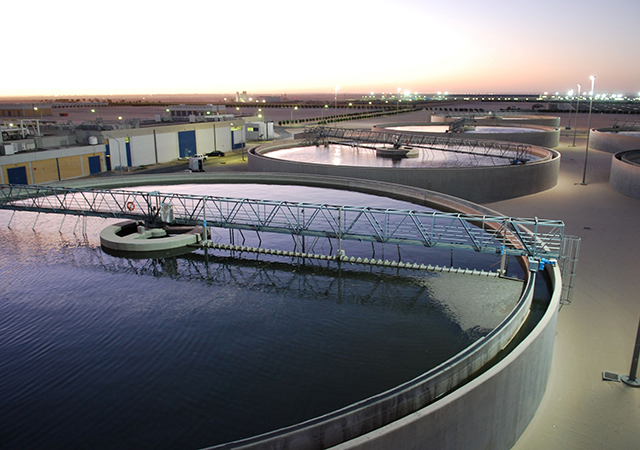
Following its success on a crucial wastewater treatment plant for Dammam, Saudi Arabia, Riyadh-based System Technology Company (SysTech) has secured yet another deal for a major sewage treatment plant (STP), this time in Madinah.
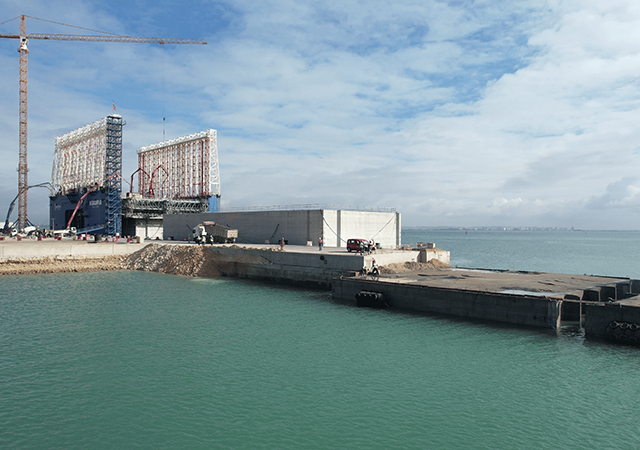
The contracting company is again relying on the flexibility and accuracy afforded by Paschal formwork systems for the construction of the SR300-million ($80 million) facility. The STP will comprise six oval-shaped tanks, with walls that taper in thickness, being 1.2 m at the bottom and 35 cm at the top.
A range of formwork systems is being used on the STP including Logo to build the straight walls with the same height of 7.2 m and length of 12 m for each casting. This is followed by Paschal adjustable radius TTR circular formwork, with a height of 7.2 m, employed on the curved sections. The project involves a total concrete surface area of some 130,000 sq m that will be formed with Paschal formwork for the vertical sections and other systems for the slabs.
Structural work on the project started in June and is expected to be completed in December next year. The formwork solutions are being supplied by Paschal-Werk G Maier, in co-ordination with its local office set up with Eifics in Dammam.
The Dammam wastewater treatment plant was the first project in Saudi Arabia to use the TTR circular formwork. SystTech selected the system having witnessed first-hand the efficiency of the system in use on the construction of two sedimentation tanks in Chambéry, Savoy, France, according to Paschal.
 |
Madinah sewage treatment plant ... Paschal’s Logo system being erected. Inset: Cross-section of a tank. |
Dammam plant
Meanwhile, SysTech used formwork on the expansion of the Dammam wastewater treatment plant, which entails the construction of 24 new circular tanks using the Paschal’s adjustable radius TTR circular formwork.
The extensive expansion of the existing wastewater treatment plant was given the go-ahead by Saudi Arabia’s Ministry of Water and Electricity to cope with demands posed by Dammam’s increasing population. Entrusted with the task, SysTech began the shell construction works in December 2010.
Phase One of the project is now nearing completion and approximately 200 men are now expected to start Phase Two work next year on the construction site.
The new structures are located on three construction sites. Each of these comprises two big aeration tanks (98.5 by 56.7 m footprint) with six coils across a width of 9 m into which the waste water is conveyed. Besides these, there are four circular tanks (external diameter 39.9 m with a wall thickness of 40 cm), two smaller circular tanks (external diameter 33.6 m) as well as conventional technical rooms.
Eight circular, cast in-situ concrete structures will stand on a footprint of approximately 400 by 500 m. The entire project will include the same facilities on three construction grounds of about 60 hectares involving a total of 24 circular structures.
“A German supervisor has instructed the teams on how the formwork can be installed on the corresponding circular footprint on site and has shown them some techniques to facilitate their work. The circumference was determined precisely to the centimetre by means of the equipment provided on site,” says a spokesman for Paschal.
For the 4.95-m concrete height, segment heights of 3, 1.5 and 0.75 m were used, that is a framework height of 5.25 m. These segments remain in height and will continue to be used. “Assembly, installation and realisation proved to be surprisingly easy,” he says. “The quantity of tie points is very low when compared with rival systems and the formwork thus needs no adjustment and no final matching of the finished construction profiles. Even though the circular formwork is a completely new technology for the team, a whole work cycle can be completed in just two days, representing a surprisingly fast construction/site time.”
 |
|
Dammam STP ... 24 new circular tanks being built using Paschal’s adjustable radius TTR circular formwork. |
The aeration tanks have an inner radius of 8.45 m, 9.15 m or 4.5 m. The external circular walls are tapering with a wall thickness of 60 cm at the base and 30 cm on top. For this reason, some steel filler pieces were manufactured in Paschal’s main plant in Steinach. These are compatible with TTR and can be locked in using bolts.
The spokesman continues: “TTR is an amazing technology in terms of handling, strengths as well as advantages for construction managers. It was developed with this kind of construction work in mind. This is a fast, easy and system-integrated solution to a challenging task.”
“The TTR is made of a 21-mm strong, 15-layer nail-on Finnish birch plywood. This is the only system that can be flexibly bent up to a radius of 2.5 m, while other types of plywood with a similar thickness would break or form waves.
“As a so-called ‘double girder segment’ (a segment with two longitudinal beams), this formwork can handle radii of up to 1 m with 18-mm-thick plywood. This makes the formwork steady, completely round and exact without any deformation, even in case of reuse. The circumference can be determined to the centimetre and with no final adjustment of the construction profiles. Although there are only 0.28 tie points per sq m, 1 sq m of formwork can bear up to 60 kN fresh concrete pressure.
“It is precisely these advantages that come into play when facing challenging technical constructions in both high-quality architecture and in the case of these circular tanks.
 |
|
The TTR system ... the radius can be precisely adjusted to the centimetre. |
“Thanks to the fast installation processes and the incredibly low number of tie points as well as no requirement for further rounding or additional support/belts, the entire formwork-making process was practical, safe and fast. In short, it is the best and most efficient system currently available. Moreover, the low number of tie points has increased the quality of the concrete surface,” he says.
Paschal-Werk G Maier, founded in 1964, is an international company specialising in concrete shuttering, propping systems and formwork engineering software. The group, with 47 years of experience in this sector, is represented in more than 60 countries where it provides comprehensive services in the field of concrete building, from development to production of rugged, heavy-duty shuttering and reinforcement solutions including global marketing and dependable customer service.
Paschal’s product range comprises systems for modern wall and ceiling formworks, special shuttering, climbing formwork and scaffolding decks, load-bearing scaffolds and propping as well as dedicated, customised software systems for concrete construction planning, organisation and management.
To respond quickly to the requirements of the Saudi construction market, a scientific and technical office has been set up this year in Dammam by Paschal Werk in cooperation with the local Eifics.
The German formwork specialist’s regional office – Paschal Concrete Forms – was established in Bahrain in 1998 and continues to support civil contractors in the region by supplying its modular formwork system and support services.